.

.
Showing posts with label Peru. Show all posts

Monday, January 7, 2013

Paracas National Reserve


Carlos is waiting, and is elated that I will go on the second tour. I have half an hour to nose around the shops, munch an empanada, and find a bathroom. The same bus is waiting, with the fat man still in his seat in the middle. This time instead of just 5 passengers, we drive up & down Hotel Row and fill every place. Good thing I hopped on early! A window near the front, like I like.
We have a guide, again an excellent one. I have not yet had a bad guide in Peru. Each one has been a great storyteller, not overdoing it, interested that you're interested. All he says he repeats in English for the three non-Spanish speakers present (me and a pair from Indonesia).
Late November is usually still flamingo season here, but this year all the flamingos left in October. A small clock came in a few days ago, and some of them are still feeding on the muddy tidal flat at the very end of the bay. The tide is out, and they are too far from the end of the permitted trail to see more than a group of pinkish dots. But we have seen flamingos!

Then it's over the neck of the penisula to the ocean coast to view the deserted coast from the top of the cliff. The land for hundreds of miles up and down the coast is barren because it never rains here. Sometimes a little mist, but even that is quickly dried by the persistent wind that prevents even cactus from getting much of a foothold. There is a little bit of life on the land, but even the insects are few and far between.
The sea, however, is teeming with fish and shellfish and the rocky coast is thick with birds come to get them. Turkey vultures catching updrafts come eye to eye with us on their way up and down.

The land is so dry there's hardly a road. Parts have been asphalted at some point, others not: in places you just make your way through the sand, staying between marker stones. When the wind comes up you can't see anything for the particles in the air, but it's calm so far today.
We come to a different-colored cliff, one full of iron, a solid rock risen up in the midst of the pale sedementary formations all around. The sea pounding this one cliff deposits red sand on the little beach just north, just a single cove of red between the blond.

We're at the tiny port of Lagunillas. There are a handful of buildings, and then twice as many cars gathered around to take the catch to town in coolers. Overlooking the boats and the inlet is a collection of restaurants where we have time for a lunch stop. It is a quarter after 2...
our guide has a deal with the best-situated of the eateries: we get a free Pisco Sour there and he says the food is very good.

I'm not terribly hungry, having had that empanada and a piece of lemon cake earlier (in anticipation of a 4-hour tour skipping lunch), but fall to the temptation of very fresh seafood. Not many meals left in this trip, after all.
I  sit with the Indonesians and a Portugese man, and wait. They take their time with our orders, and then with the food, and an even longer time with the beverages. In fact, we have to ask four times to be served. The ceviche is fine, but I have gone for the fish soup, having not yet tried it in Peru, and it's quite lame. It's like a can of Campbell's chicken-noodle, minus the chicken, and with bits of tasteless fish in it. The pisco sour, when it finally arrives 30 minutes after our arrival and after many reminders, is not even any good.
Having wasted most our break trying to have this meal, I would like to pay my bill and go for a stroll and some photographs in the last ten minutes before the bell (we really can't tarry, because the Indonesians have to catch their bus to Lima at 4, otherwise we would all just relax and go with the day as it unfolds). All I have is a 50 soles bill, and they don't have change.
So they just don't bring me my change.
I insist with the waiter, twice, who says they're working on it, and I eventually go inside to make something happen. They're just arranging silverware back there. The owner has a 20 and a 5, but owes me just 24. What, they're just waiting for some coins to walk in the door? No other customers are here; that could be a while. Finally they give me a 1-sol discount on their bad soup and worse service.
Time to get back on the bus already – no exploring this lonely spot. Next time (what next time?) I will try harder to ignore my stomach, and satisfy my eyes instead. That's never worked before, but it might some day.

Back in Pisco I have a shower and a rest (it's so tiring to sit on boats and busses all day! Seriously, you pay such intense attention to vistas you'll never see again, that a 9-hour day is exhausting.) before going out to arrange my bus back to Lima tomorrow.

Saturday, January 5, 2013

Friday, January 4, 2013

Ballesta trip

In the morning I'm awake long before 7. Since I don't have an alarm, I'm always afraid if I sleep deeply I'll wake up and it'll be long past 7. So I just dont really sleep. Carlos, the Aloha Ballestas kid, comes around promptly at 7, and we are the first on the bus that makes a tour around central Pisco, picking up an immensely fat man who seems to be the boss of the operation, and passengers from other hotels.
In Paracas we join the long line of people waiting for the speedboats out to the islands. Most of us are Spanish-speaking, from other parts of South and Central America. A few are from Europe or the US, but not many.
The line advances as they collect more and more money from us and lead us onto the boats that seat 40-50 each. It was so much for the tour, plus now a little bit for entrance to the national park, and an extra coin for access to the floating dock. It's all to be paid separately. It isn't much, but it would feel much better to pay it all at once, even for the same final price. This way we feel nickel & dimed, always another hidden cost.


This slight irritation is fresh when Carlos asks me if I would like to take a tour of the Paracas Natural Reserve after the boat trip. Just 25 soles for 4 hours. Yeah, just a bit more, always more. I say no.
But as we head out to sea I think about it. We'll be back to shore in just 2 hours, well before noon, and what is there to do with the rest of my day? I've seen I won't get far on foot in this vast desert. Paracas can't be visited on foot, just wandering around for an afternoon. This austere country is beautiful, and they don't want much to show more of it to me. Sure, I'll go. 


The boat stops first for a view of the Candelabra, a gigantic carving on the mainland only visible from the sea. Cool. Nobody really knows why it was made, or when. An enigma.
The Ballestas are a cluster of very complicated rocks, full of arches and tiny beaches and coves. Not so long ago guano was extracted from the hieghts, and the large iron structures for loading ships with the valuable fertilizer are still present, rusting and covered themselves now with birds and droppings. Guano today is collected only every 6 years, using nothing more sophisticated than shovels and rakes, and during the 4-month season farmers come from the Andes to return home with what they can gather.


The 300,000 birds on this cluster of rocks produce not only a valuable commodity in their excrement, but significant tourist income. We come in droves in the speedboats and we are all awed by the thickly covered slopes and crags, and the way the birds, and the sea lions resting on the beaches and lower crags, are so accustomed to the approaching boats that they let us come right up.


We spend an hour in and around the rocks, dancing with the other boats, turning left then right so that everybody gets a front-row view. The time flies, and then we head back to shore.


Thursday, January 3, 2013

Pisco


In the morning I am Pisco-bound. Michel calls me a taxi and gives the driver directions for a bus station on the southern edge of Lima. It's not like the station for Huacho, where there were half a dozen competing companies: it's a private terminal for just one luxury bus line.
In fact, they don't stop at Pisco. Errr... I can go to Paracas, the resort town just south of Pisco, and get a collectivo back up the coast. Well, there aren't any other buses here, and I don't even know where another bus station might be. Collectivos are no big deal, so ok for Paracas.
This is one luxury bus! I get a front-row seat upstairs, next to an artist from the Netherlands who spends his time between South America and Europe. He's the one who explains what  the deal is when the steward comes around and snaps polaroids of all the passengers – identification in case of accident. Yes, I will be wearing my seatbelt.
They serve a light lunch, but I didn't know that so I had lunch at the restaurant in the station during my 3-hour wait. My seatmate has been on the bus since Trujillo, in the north, and he's happy to eat both lunches. The upstairs is great during the day, he says, though he cannot get them to shut off the idiotic movies that run continuously with nobody watching. Downstairs are the sleeping compartments, much better for night travel.

Lots of cars are competing to take people between Paracas and Pisco, a 22 km stretch that passes an oil tanking company, a huge fish processing plant, acres of hotels and vacation homes under construction, a military base, and finally something picturesque the fishing village of San Andres. Mostly the collectivos take local people to work in Paracas and back again – usually the tourists are staying there in the big hotels and don't need to be ferried back and forth.
Pisco itself is full of dusty, unpaved streets and tranquil dogs, with a few paved main roads and two flowered squares in the center.
My hotel is on one of the squares, the smaller but more animated of the two. All Pisco seems to gather here in the evening. I appear to be the only hotel guest in this off-season, and they give me a room overlooking the square, right above an appliance shop that demonstrates its audio equipment daily until 9 pm. There not being an appliance shop on the other square, perhaps the constant music is why everybody gathers here. At any rate, to my happy relief the shop shuts at 9 and everyone goes home then.

In the evening I wander around the central area, snacking on empanadas and strawberry jello and popcorn. My borrowed guidebook recommends not wandering too far down the small streets, and indeed there seems little reason to do so.
In the morning I walk down to the beach early, before many people are about. It's about a mile, and just at random I take what turns out to be one of the best routes. For once I don't go off in the wrong direction! The tide is in, and the sandy beach that remains is not as polluted as that at Huacho, but still not a place you'd come lay a towel and spend the day. The people here ignore the beach; it's not the place to go it is where I come from.


To the north there's an abandoned pier that used to serve fishing boats unloading their catch. A large section has been washed away, and the part out in the sea is now a nesting place for thousands of cormorants and pelicans. The rusting and barnables structure is absolutely covered with birds.
A pair of men are fishing from the end of the land-based section, and another is bicycling our toward them. I take a photo of the cyclist in his bright shirt against the blue-grey day – a long shot in which you can't identify him. He looks toward me just as I have the camera to my eye. Caught!


When I down the pier to see the birds better, the old man fishing chews me out for taking a picture of someone without asking. He's outraged. Livid. He goes on for quite some time, and eventually leaves to walk down the beach. The subject of my photo just fishes silently from the end of the pier, ignoring us.
I'll be more careful. I would never take a portrait without asking. From the distance between me and the cyclist, it would have been difficult to ask. It's not as if I'll be making millions off my stolen image, either. I'm not a pro who will be selling anything.

The heavy overcast is just starting to lift when I get back to the main square. It may not be such a grey day after all.
I'd like to go out to the Ballesta Islands tomorrow, to see the flockes of nesting seavirds there. And sea lions, lots of sea lions there. The receptionist at the hotel doesn't speak much English, so when I see a tourism agency in the street connecting the two squares, I stop in. The guidebook recommends booking through the hotel (they have an interest in keeping their clients happy, so don't generally send you to crooks), and the next-best thing is an agency with a fixed office. Never deal with people who approach you on the street – too easy for them to disappear. (Sometimes I find this book just a bit too cynical. But then again, I haven't been burned yet...)
Pisco Tours is in an alcove of a hallway full of mini-shops. There's a kid of maybe 15, a computer, some brochures, and a sign. Low overhead. A tour of the Ballestas is about what I've heard it should cost, and they'll pick me up at the hotel at 7. Half now, half tomorrow, and it's a deal.

Having seen Pisco, at the end of the morning I catch a collectivo to Paracas to check out the seashore there.
Paracas is not like other towns I've seen in Peru. This is a resort town built for visitors and not much else these days. Every building is a hotel or a backpackers hostel ot a restaurant or a gift shop or something related. The people who work here mostly live in Pisco, taking the continuous stream of taxis back and forth. In contrast to the past-glory feel of the abandoned and ruined hotels along the Pisco beach, here a dozen huge complexes of holiday condos are going up. They've decided where the future is, and it's not in salt-mining any more. The beach is clean and nice (except for the morning's tide of jellyfish which have not been cleared away yet), and the pelicans are expecting to be fed.

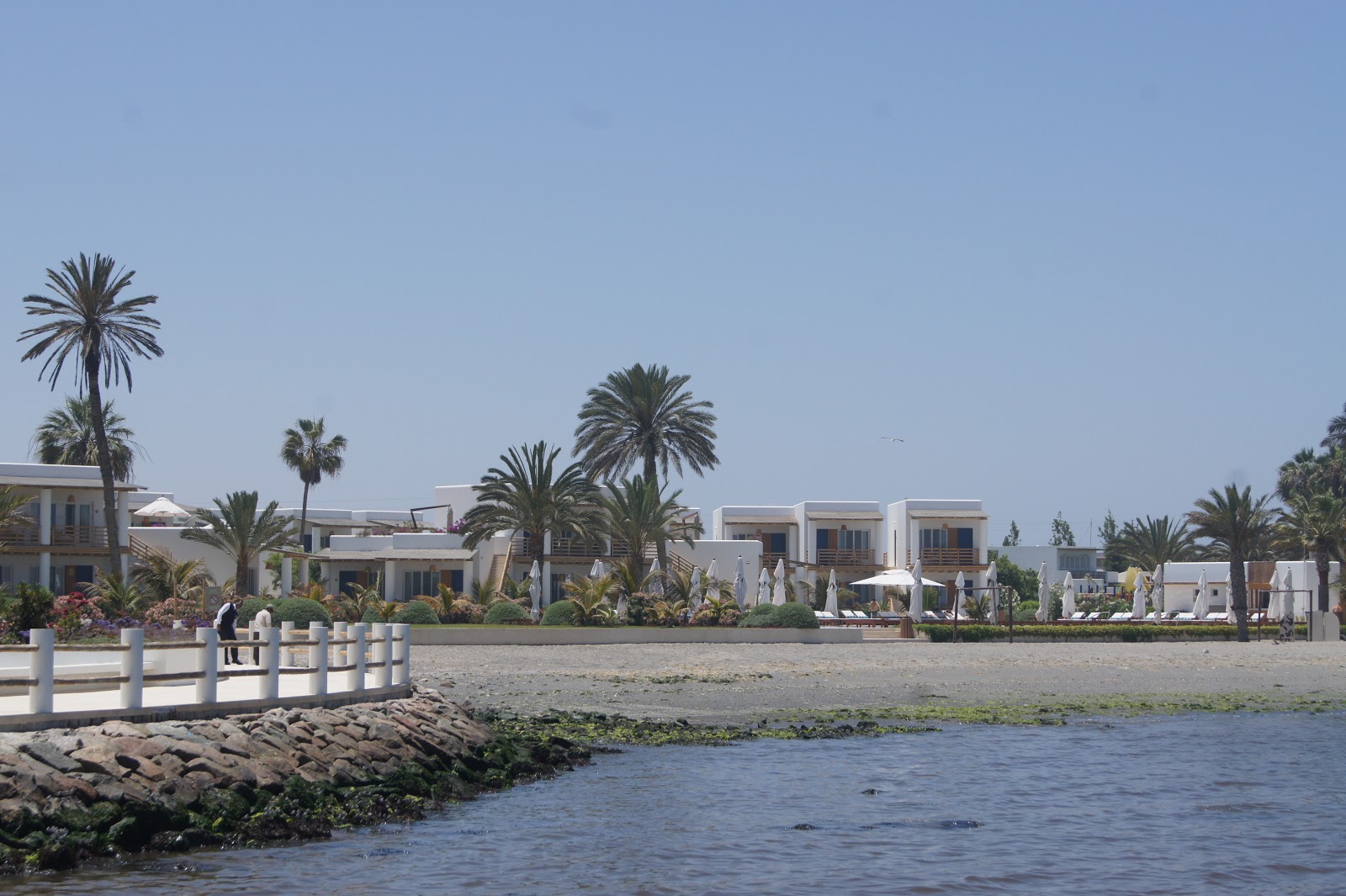
There's a small port at the north end of the bay, with dozens of anchored rowboats, as many more small fishing boats, and a special dock for the boat tours to the islands. Facing this is a short promenade along a sandy beach, lined with restaurants.
I walk up the main (nearly only) street, past the center of the town, out past a handful of luxury hotels and then past some private homes such as you might see in La Jolla or Malibu. The road ends at an especially grand house, though construction continues further along. Here there's a small park with a statue, and access to the waterline.
I'd like to continue my walk away from town, and with the road blocked by construction I try the waterfront, but the big house blocks the way with a private dock and a fence. To my right, back to town, there's a sidewalk between the houses and the water.
It's interesting that these houses have high walls and gates and hedges guarding their privacy on the side facing the road, but on the seaside everything is open. There are no fences, the manicured yards come right down to the concrete walk. They don't much believe in curtains, either; you can look right in, go right up and sit down on the comfy deck chairs, play with the toys left out on the lawn.
Nobody seems to be in, aside from the gardeners.

On the water-side of the path the shore is rocky, and a great deal of algae has washed in along with the myriad jellyfish. Too fresh to be very stinky yet, but it'll get there! The crabs are already at work, but it would take a serious army of them to clean this up. And they won't touch the algae at all.
I come to the very exclusive Somethingorother Resort (I'm not saying that to not say their name, I just really forget what it's called), and just walk right into the grounds and onto their boat dock. Perhaps in Peru, as in other parts of the world, shoreline is considered public property and cannot be fenced off for private use. I don't know. I do know this hotel is a fortress on the road-side. Trying to continue back to the sandy beach and the town, however, I come to a serious fence.
No access here.
Free access from the ritzy-house side, come on over for a drink at the pool. No access from the public beach side.
Guess nobody thinks to just walk the long way around.

I find my way through the maze of paths and buildings to the reception area and out to the car park where the gate happens to be open to allow a mercedes to enter. I escape.
Lunching spots abound in Paracas. Lined up along one street are identical terrasses set with their menus all advertising the same fresh seafood dishes. Which one to pick? It's a random choice.
The ceviche at the second-to-last one is excellent. As I've noted before, how can you go wrong, right next to where they're bringing in the fish? And I miss fresh seafood. They really know how to fry things here, too. The fried filet is light and crisp and not at all greasy. Perfect.
At the far end of the beach, past the tourist docks and before the fishing docks, is a row of souvenir shops. I need a hat, and I'd like to find a present for a friend's birthday next week, plus this xhoulder bag is on its last outing. So I look it all over, and discover that ther's really just one shop. They all have the same stock of t-shirts, hats, bags, and trinkets. Ok, there is some variety in the jewelry down at the end. But I see those Made in China stickers!
Seriously, exactly the same stock.


Wednesday, January 2, 2013

Caral


In the morning I leave my overnight bag at the hotel and catch a collectivo to Supe.
4 soles for 30-40 minutes in a rusty car with four other passengers. At first I ask for Vichama, a village not far from Huacho on the map on the wall of the hotel, where Michel recommended some interesting ruins, but the driver misunderstands and tries to drop me off in the middle of nowhere, just a blip on the road with a gas station and some scattered shacks and a more or less similar name. 
Oh, no! Don't leave me here, please. Supe! Supe will be fine.
The Caral ruins are quite well known, and in Supe it's easy to find a ride there.
The site is the new 'thing' for visitors to the country. Private tours can be had for $250 from Lima, and they quote me $80 in Supe.
Yeah, right!
I'll just take a collectivo and see it on my own. Collectivo, no problem. We take three other passengers and drop them off at their farms along the green river valley before ending at a vast, empty, parking lot a mile or so beyond a cluster of houses. This is the pedestrian entrance to the site of the oldest known city in the Americas. 3000 bc. Pre-pottery people, way before the Incas.

From the parking lot it's over a mile to the visitors center. There's an even vaster parking area here, ready for busses chock full of tourists. Caral isn't in the books yet, but it very soon will be! That's for next year- this morning I have the place to myself. Or nearly – one car pulls in as I descend from the lookout hill to the complex. There are two souvenir sellers open in the row of a dozen permanent booths. The dining area has plenty of tables and spaces for a dozen vendors, but nobody is there yet.  The ticket area has the official souvenirs – the t-shirts, mugs, postcards, books and stuff. I would like the less expensive soft-cover book in english, mostly as a guide to my visit, but the cashier doesn't have enough change. I promise to come back for it once other people have arrived and paid their admissions.
The morning haze is burning off now, and I hope I don't regret my lack of sunscreen or a hat, but there's nothing to be done for that now. No Caral hats at the shop. A good look at the map, and off I go.
And I'm called back.
All tours are guided. Wait here.
The sign, now that I read it, says that groups must be composed of a minimum of 20 people, with a maximum of 20. We are to pay the guide 20 soles, in addition to the entrance ticket. In the exceptional case of fewer than 20 people, we still have to come up with 20 soles.
A family of 6 has arrived, but there are no signs of anyone else heading up the dirt road. We do set off with 7, and there's no mention of the further fees. Ok, whatever.


Our guide certainly has the archeological training and guiding experience promised by the sign. He sounds like a young professor, and answers the myriad questions from the family patriarch patiently.
The Caral site was discovered less than 20 years ago, perhaps less than 10 I can't be sure. It's just at that stage when they know it well enough to know where they can put the parking lots, and they've made a good start on the infrastructure that will soon be necessary. On the other hand, it isn't overrun yet.
The perfect time for a visit.
And the visiting is something they're starting off doing right. You're not allowed to just wander anywhere, trampling the delicate desert plants and erasing whatever artifacts are lying just at the surface, spreading gum wrappers and empty water bottles among the ancient building stones. The prices too are geared to different walks of life: tourists pay a premium, nationals pay something more in line with the country's wages, and locals visit their own heritage for free. There are lots of marked paths, so if you take the longest tour you get most of the photographs you want.
Yes, there are birds here.

The Caral people didn't make pottery or work metals, so they didn't leave a lot of durable stuff behind. They did organize their lives with agriculture in the fertile valley and the city up higher on this perfectly barren flat between the hills (at least, it is barren now; perhaps then there was rain along this coast). The city has neighborhoods and pyramidal structures for bith residential and ceremonial use. Two perfectly round ampitheaters occupy the middle of town, and the place is overlaid with many significant alignments having to do with the positions of the sun or the moon. The whole place may have been a gigantic calender, continuously elaborated as the town grew.


We're done with our short-version tour at noon, and by now two busloads and a couple of vans have made the parking lot look not so hugely oversized. The place is alive with people taking in a bit of history, walking the dusty paths among the ancient ruins, and perusing the wares of todays vendors.
The food vendors are set up. There's a woman selling boiled corn, and another with some kind of chicken-potato stew, and a vat of chincha-morada, a thick beverage based on purple corn. I take just a giant ear of corn, with a smear of extremely hot peppers down one side, and a chincha morada, and that's a great lunch.

The walk back to the modern village of Caral under the leaden sun convinces me I really need a hat. I was the only person in my tour group not to have one. The ladies selling things at the far parking lot have some for 8 soles, a deal for a ball cap. But I have just 10 soles in coins, plus a bill of 100 they'll never be able to break. Getting back to Supe is going to take more than 2 soles, so I do without a hat. At this point I'm down at the level of the nearly-dry stream, and the tamarisk trees, then eucalyptus, provide some shade.

The corn in the fields is gigantic. Not that the stalks are taller; they're fatter. There are way more leaves, and more fat and delicious ears, than I have ever seen on corn. Passing a field ready for harvest, I filch a few grains from ears just bursting out of their leaves. Perhaps it will grow in my garden at home.
Approaching the village, a car in the middle of the lone intersection starts honking, so I wave and it comes to get me. I'm getting the hang of this. Cars honk lightly just to announce they're there. They honk if they're looking for passengers, too, and on the way up the valley we honked at every farm, in case anyone needed a ride. Guy in the middle of nowhere honking? Must be asking if you want a lift.
In Lima I would never have taken a ride from a rusted-out beater like this one, but here it's just what there is. If it were 5 km to Supe instead of 23, I  would have taken the hat and walked for the exercise. 23 is too far in this sun, so I hop in and off we go.

In Supe, I consider wandering around for a while, maybe down to the beach. But it looks like the town beyond the area where the collectivos gather, where there are a couple of shops and places to get a beer or a snack, is just dirt roads and shacks and people minding their own business. I feel out of place, like I would be intruding if I went any further, so I don't. The looks I get, with my gringa face and my big camera, aren't inviting.

In Huacho I discover that however tasty even a giant ear of corn can be, it doesn't last very long in the tummy. With all those fishing boats in the harbor, there must be some excellent ceviche in town. Time to go find it.
All the way down the main street, past my hotel and almost to the beachfront mall, I find Tia Mauro's. There are six tables, five of which are occupied with families having their Sunday meal. The sixth is a little table right on the sidewalk, and it's for me.
Such heavenly fish!
Chunks of the catch of the morning, onions, cilantro, lime, vinegar, what can go wrong? more do you need? A nice cold beer, certainly, and they have that waiting for you.
The bus back to Lima shows two more boxing movies. It's a boxing sort of bus company, I guess. Z-Buss.

Tuesday, January 1, 2013

Huacho


I can take a bus on Saturday for Huacho, a beach town some 3 hours north, then in the morning catch a « collectivo » to Supe, and from there another to Caral. It will be an adventure, but the people in this area are nice. I will be safe.
At the bus station I grab an empanada and a churro for lunch before boarding my bus. They don't let me get on the one at 10:30, probably because it was full. The next one is pretty well occupied too but I get a seat. It doesn't seem like too bad a bus. In France it would be retired, but here it's decent as busses go.


A boxing movie is just ending, and they put on another, a John Leguizamo about a poor boy from the northern US making it big in Vegas, then going back home after losing it all. You can't help but watch it – all the curtains are pulled against the sun.
We make stops along the way. I wonder how people know to gather at one place and not another. On the bus they take your name and your number when you get your ticket. A guy tells me later it's to help work out who's who after a crash. At the stops there are people selling snacks, they crowd up to the windows and do their trade from there. The empanadas are hot, but can you trust them?  Yeah, sure.


The countryside here is utterly bare. Not even cactus on the pale hills. The occassional slopes that are not bare are covered with shacks. It's a wonder anyone can make a living out here. What do they do? Is there plumbing out there? What is there to eat?
Large areas of bare ground have signs « concessions » to some company or other. Mineral rights, apparently, though nothing seems to be happening, no mining going on. Some high spots have watchtowers. What for? Is anybody watching?
The coast is not a strip of green. It never rains here, for miles up and down the coast. The green is along the rare streams running down from springs in the hills. Those valleys are lush with trees, corn, bananas, sisal.


Huacho is a poor, dusty town of not much. There are signs for hostels, but I figure my best bet for some comfort is closer to the beach. Tourists like beaches, so any hotel catering to tourists will be near the beach, right?
I walk the long avenue Martin to the end, finding only places that might be ok if there's really nothing else. I'm not so young any more; I require a clean bathroom and a bed without insects and doors that close & lock. Most of these places probably have that, but it's very easy to imagine they don't.
At the beach, I look up and down the coast, but there's not much development along the waterfront except for the big mall and a couple of restaurants. Not a single hotel sporting a view.
I turn around and go back toward the center of town on the main street, parallel to Ave Martin. In just a few blocks I find a real hotel. With a restaurant and a pool and all. It's fine, though the lack of insulation makes me hope the screaming kids having fun at the pool will wear themselves out early.


Now it's time to see the beach, and the ocean I've been missing for years now.
There are a great many birds, and I take a very great many pictures of them. Alas, it's also the most polluted beach I've ever been to. Garbage everywhere, both washed up by the tide and (mostly) thrown down from town over the low cliff.
In a fresh water outlet, people have gathered to wash their clothes. I can't imagine that. Well, I can imagine washing clothes in an open stream. But when my clothes are dirty enough to be washed, they're still cleaner than what comes out of that water, I'm sure.
Pampered American. These people have no other means of washing. No plumbing to wash at home, if they are the ones to live in the shacks on the bare hills. Laundry shops are common, but relatively expensive. It's this or not wash.


Fishing in the surf. Nobody swims there : too polluted.
Everybody is outside for some Saturday afternoon sports at the beach.


Monday, December 31, 2012

Conference, bis


The second day of the conference most of the Europeans have to leave for the airport by 4, which is a shame because the talks don't end until 5:30. Again the translator is often absent for the talks in Spanish, but we all seem to communicate anyway.
There's a 90 minute break for lunch, and my friends and I figure people will split up for the many small restaurants in the surrounding blocks.
But no, last minute change, all the invited guests are to be taken by taxi for lunch together at a big hotel overlooking the beach.
Ok.
Peruvian schedule.
The people speaking in the afternoon session begin to worry about their talks when we are still not seated for lunch an hour into the break. The day, after all, is not extensible with half the audience leaving at 4.
(But what does it matter? All the speakers for the session are here at lunch, as well as the majority of the audience. Just project the slides on the wall!)
After the inevitable Pisco Sour and halfway into the ceviche starter, we applaud Jenny, whose talk is now « over ». As the main course is served it's Eva's turn to be lauded for an excellent phantom presentation. Helle should be up next, but the schedule is being rearranged so everybody can talk really really fast once we get back to the meeting. 

The Scandanavians are indeed very efficient, and amazingly the session finishes at the bell. Goodbyes are said all around, and we will all see each other soon in Lund.
For the last session, in front of the now nearly empty auditorium, the translation booth has again packed it in. It's just Xana, JB and me now for the visitors, and Xana translates key words for us as needed. The last talk is Mev's own, and she wraps things up magnificently.

And that's it. Now the Dominguez family can sit back and relax. They've all been going full speed to make this conference a success, and they've done a wonderful job. I've been amazed at their energy, and now I see the flip side as once back at the house all is quiet in the calm after the storm.
Everybody collapses into armchairs to discuss what I might do over the weekend, before heading south to Pisco on Monday. A new archeological site has opened to the north of Lima. It isn't very touristy yet, so organized tours are expensive and facilities there are limited. On the other hand, it won't be  very crowded, you can see it without an organized tour, and it hasn't been spoiled yet by busloads of camera-clicking hordes. Sounds like just the ticket.

Sunday, December 30, 2012

The Conference


The first day of the conference we are to visit two clinics, one private and one public. Driving by the public one yesterday, it looked from the outside not any better than the one I toured in Algiers. We have to skip that tour, however, because we are on a Peruvian VIP schedule, and arrive 45 minutes late at the hotel. We might have been on time but for two factors:
-        the bus leaves the house when the Professor is ready, and not before.
-        We have a bus (a small bus) with the most timid driver in Lima. Well, except for the time he almost ran down a small child while cutting through a residential district, but against cars and trucks and even scooters he's a wimp.
So we load up the bus with the rest of the group at the hotel and go straight to the private non-profit clinic. It's a rather nice place. It used to be a private mansion with extensive gardens, then a motel so the buildings were cut up into  lots of rooms with baths, and now this clinic takes full advantage of both the former lives of the site.
Here we have breakfast in the conference room, and a translated discussion with local doctors. Very informative. If there's a gap between 'the latest' at my university hospital and theirs, there's a yawning chasm between that and the everyday medical corps. We need to stay more than an hour, more than a 2-day conference.
Passing the free time before we gather for the afternoon talks at the meeting venue, everybody retires to their rooms to work on their presentations (didn't they do that yesterday?). All but me. I'm only talking ten minutes on next-generation sequencing and furthermore not until tomorrow, so I go for a stroll in the Miraflores neighborhood, reputed to be the nicest area of Lima.
It is nice. You could be in San Diego. The beach is a dozen blocks away. I stop for a Starbuck's coffee and head to the mall to see if I can pick up one of those colorful Peruvian bags as a carry-on, and maybe a cheap pair of sandals.
Nothing doing. The mall could be in California too: American-type goods at American-level prices (and you can even pay in dollars for those Himalaya sandals and that Rockport backpack). There are a few Peruvian souvenir shops along the street, and I do get a bag there, but I notice for the other souvenirs that interested me as gifts, that the prices were better at the airport. I'll wait.
I need the bag, though, because I'll be taking a bus and then a collective taxi to Pisco on the southern coast on Monday, and I figure it's both safer and less annoying to travel light. I'll leave my big bag with Mev's family's house, and stay there again my last night in Peru.

The afternoon talks are good, though there's not a whole lot for the European speakers to learn from each other. We're here more to impart information to our local audience, and to develop collaborations with them. Perhaps on this assumption that we have « nothing to learn », the translation of the talks in Spanish into English is lacking. After the last talk in English, the translator packed up and left.
In the evening the university has a surprise for Mev – we're not just eating in some restaurant; we're to be given a tour of some of the old university buildings, and dinner on the porch of one of the cloisters, with ethnic dancing and a live band to entertain us.
Quite the gala!

Getting there is difficult. Our bus is stuck in traffic, as usual, so eventually the visitors are paired off with the locals, either in taxis or personal cars, and off we go in 3's and 4's. Exiting the meeting center, there's a woman holding up traffic because she's trying to get adequate directions to our destination. Our driver kindly tells her to just follow us, and the relief on her face makes me suspect that this lifeline has instantly cut off all attention to how to actually get there. It's dark now. Traffic even on this small road is heavy, and we lose her after the first turn.
I'm in a carful of French speakers – Xana, Jean Baptiste, and an elderly professor at the School of Medicine. One of his daughters is a pediatrician in the US. He spent some years training in Strasbourg, and we talk of medical training in different countries for the 20-minute battle of the streets of Lima (for a mild-mannered professor, he's just what you need at the wheel in Lima - perhaps he'd like to drive the bus tomorrow). At one point I joke he's not taking us to the university at all, but kidnapping us to make us teach molecular genetics all over Peru. There is no need, I say, we will happily come back and give as many classes as you want.
Little do I know this is the Dean of the School of Medicine, he will joke about kidnapping us in his speech later, and that not only workshops among the elites (such as today), but classes for all the students will be suggested for a new meeting in two years.
You really can get as much done in a casual car ride as in an official meeting sometimes. More, even.

The original University buildings are no longer used for teaching, but have been preserved as a national monument, and serve for various functions like ours. We are ushered into what used to be a room for presenting one's thesis, with a head table & three gigantic armchairs on a raised area facing rows of high-backed wooden benches, and a lectern at one side for the postulant. Everything is opulently decorated, from the carved benches to the painted and gilded ceiling. Once everybody arrives there are speeches of welcome and we all receive certificates of Associate Professor for our participation.


Then comes a very long and scholarly – and dull – explanation of the history of the room. A little history is welcome, but one this long and detailed overruns interest by a good deal, especially when we cross a cloister to view another room. No, we're not ready for dinner yet!
This room is as austere as the other was opulent. There's nothing to distract us now from noticing that the speaker always closes his eyes to talk, and then pauses to look only at the translator. Not once does he look at his audience, and indeed he's not talking to us. He's not interested to see if we're interested. He's just talking to himself.
He seems very satisfied with the result.

We are seated at tables of 8 for dinner, and people stay fairly segregated. Only one person at our table doesn't live in Europe: Mabel from Columbia joins us. Her English is limited, as it is for many of the Peruvian guests, which is probably the main reason for the segregation. It's a shame we don't take more advantage of this social time to build links between our groups. At the same time, I know how tiring it is to spend hours communicating in a language you don't really master.
The band gets going, and it's time to dance.
Ah, here's the first round of Pisco Sours, and some little sandwiches. They're pretty ordinary little sandwiches, and we all try to hold out for the real meal to come. Except JB. Any plate with a sandwich still on it eventually makes its way around to JB's part of the table and is cleared.
As the last of the plates is emptied just as the waiter is trying to whisk away the last crumbs in order to serve the starter course, I say to Helle that JB's dog would starve, provoking hysterical laughter that infects our whole section of the table. Jenny vows to remind Helle of JB's dog just before her talk tomorrow. That should lighten things up.
The evening fills with food and drink and dancing, both on our part and by a group of a dozen students doing a traditional display. 


Saturday, December 29, 2012

To Lima


The hotel staff kindly sets out breakfast around 5:40, and Lucio doesn't come around until 6:10, so we have plenty of time for coffee and wonderfully fresh pineapple and watermelon. The night rain tapers off and stops just in time for us to load our luggage on the top of the van and rush to the airport. The mountaintops are dusted with snow this morning.
Our flight is meant to board at gate 2 at 7:40, but at 7:15 nobody from our airline is there. Then another airline appears there at 7:40 and a crowd gathers  for the 8:15 to Lima. Hey! What happened to us?
After quite some effort, Mef tracks down the lone Peru-Air person in the terminal and extracts information from her. Oh, the plane is late, and there's no gate yet. You will go at 8:35. I will make an announcement when the gate is fixed, she says.
Any gate announcement must have been unintelligible, but we learn by word of mouth that it's number 4. There is eventually a boarding announcement, asking for the back rows first, and a huge crowd leaps up. Having forward rows, we decide to let the line shorten before getting up with all our hand luggage. The crowd ebbs and grows again – must be a really big plane. Then we hear our names being called on the loudspeaker. Apparently there are two flights boarding at the same gate at the same time, and we are the last passengers for ours. Well, thank you for making that clear!

Most of our group is staying at a hotel in the Miraflores sector on the coast, but Eva and I are staying at Mev's family's house on the north side of the city. Mev has a lecture to give at the medical school, so we drop off our stuff and turn right around. The plan is to join up with the others for a tour of the old downtown.

Michel drops Mev off, and although it's only a mile or two to the central square it's not easy to get there through the crazy traffic and one-way streets. At one point, there's  construction blocking one way at a T intersection where both of the other streets are one-way toward the blockage. What do you do? Just drive the wrong way for a block and honk a lot.
Eventually Michel drops us off at the Plaza de Armes, with the presidential palace on one side and the Cathedral on another. Mev recommends strolling down the pedestrian-only shopping street to the Plaza San Martin, or visiting the catacombs under the San Francisco church and monastery. Or both; they're not huge places.

Mef and the others haven't left their hotel in Miraflores yet, so Eva & I figure at least half an hour before they join us. The cathedral steps seem the most visible place to meet, so we fix that and wander off in search of a snack. At first we think to be choosy, but hey, it's just a snack/lunch before a huge dinner, so any little place will do. In fact, we settle on the first place we come to with seats available. 6 soles (about $2.25) for a starter plus main dish and beverage. Among the 3 starter choices none rings a bell from our Cuzco experience, so we pick at random. Mine is boiled potatos in some minty sauce, quite interesting. All the main dishes seem to be chicken-based, and I end up with fried chicken while Eva's comes in mystery sauce. The fried chicken is among the best I've ever had, light and crispy but not at all greasy. Plus rice and a pile of fries. I like the fries here; they're not made from the usual kind of potato, and they have a certain body to them inside the crunchy surface. Eva and I both pass on the strangely chemically colored beverage included in the special, insisting instead on bottled water that must be fetched from next door.

Once we finish, I would like to poke around just a block farther away, where they're constructing some kind of waterfront for the river that passes through the city, but we're going to be late for our rendez-vous if we hang around much more. (we've not yet learned the reality of Lima traffic) We do pause, though, for plastic cups full of jello and custard. The bottom bright yellow layer is vanilloid custard, then strawberry jello in red, topped with hot pink whipped strawberry jello.
When Mef and Carl, Inge, Helle, and Jenny arrive, they too want to have lunch before exploring. So we set off down the first block of the pedestrian street in search of their happiness. No luck on the main street, but down a side street there are plenty of little eateries. They settle on Chinese through a lack of willpower to search further for a place with a large enough table. While they order and eat and chat in Swedish, I go around for some photographs.
I love this group. When I get back they're really interested in what I saw. Which is cool, because we won't be going that way for them to see for themselves.
It is decided to visit the Catacombs first. It turns out I am the best navigator in the group, which is surprising because I tend to look at a map, choose my landmarks and my route, and then start instantly in the wrong direction. This time, I spied the spires of our destination while out on my little excursion, and we are saved.
On the way, Eva and I recount our own lunch, and Helle remarks that she's a great fan of jello, so at the next jello vendor, and there are a great many so this takes less than a block, we stop for one. No custard for Helle, just jello.
As another detour, we discover that you cannot walk around the back of the presidential palace.
This makes perfect sense if you think about it, all those presidential deliveries & getaways & whathaveyou. But who's thinking? We're on vacation, and we have jello.
San Francisco church and monastery

At the San Francisco complex, there are no self-guided tours. You wait for a guide who speaks a compatible language, and he will take you around and show you what he feels like showing you. It's a big place, having previously housed up to 400 friars, although today there are only 30. They rent out some of the space for exhibitions and a school now. This makes for a curious tour. We leapfrog other groups, skip some rooms, visit others, and seem to see things in no logical order. If you took the tour again you would surely see a different selection of the possible sights.
Common to all the tours is the visit to the catacombs, and probably the library.
The library is about ¾ full of old and ancient books, the empty shelves waiting for volumes to return from restoration work, or scanning. Unexpectedly, the books present are just piled right there on the shelves, unprotected from humidity or bugs or anything. Just a braided rope to keep them from theft. Most of the volumes are stored sort-of upright, not being packed tightly enough to keep them from leaning. That must be great for the bindings.
While they last, the books are fabulous. With official permission you could probably read one. The gigantic illuminated hymnal open on display is gorgeous. Sing slowly – they turn the page once a day.
Around the main cloister there's an art exhibition, with paintings for sale from local artists, with mostly local and religious themes. Some of them are quite interesting. Our guide studiously ignores these as he whisks us along to listen to the history of the remaining original frescoes more or less visible above and between the canvases.
The gardens are beautiful, full of flowers and slender trees, but we are allowed no dawdling to admire them. No photos, either, of the exceptional architecture. Our mission is to get through the lives of the early friars and patrons of the church, to the catacombs below. This place is so obviously alive, continuing to evolve from its beginnings through to modern times and new uses and policies, that it's odd to tour it as if only its first century mattered.
So on to those catacombs. These used to connect most of the major buildings of old Lima, and not just the religious ones. The tunnels are mostly blocked off now, or collapsed by earthquakes, leaving only the bit below San Francisco accessible.
Bodies used to be piled high in the niches, and to make room they would occassionally take all the old bones of a niche and throw them down a large pit. Tens of thousands of bodies were laidto rest here.
Today the bones that have not turned totally to dust – the femurs and tibias and skulls that are our thickest bones – have been sorted by type and laid in neat designs in the niches open to view, and the pit that's part of the tour contains a rosette of skulls and tibia.
Helle finds this design macabre, but then, tossing them in a pile would hardly be nicer. This way, they have taken care with the remains, and shown such respect as is possible for keeping them on display at all. In rooms at the periphery of the tour, there are just piles of dusty grey bones and drifts of fragments everywhere.
I dunno. I think I can skip catacombs in the future. I am neither interested in seeing the display, nor paying my respects: there is just no point in coming here other than that my comrades are here and I didn't fancy waiting around outside.

A caged trash bin.

Outside, Mef and Carl decide to go back to the hotel. A few blocks later, Helle, Jenny and Inge decide to do the same. We've pretty much seen the 'sights': outside of the cathedral (they charge to much to go in), Catacombs, Presidential Palace (again, just the outside), the main square. The pedestrian shopping street we've had a taste of, and with the absence of any uniquely Peruvian shops, it doesn't grab us. My friends would rather get back and put the finishing touches on their presentations.
Eva and I decide to go with the pedestrian street down to the other square, San Martin, just for the walk. It's only about 10 blocks. In fact, it's rather one block of shops, reshuffled and redealt ten times.


At San Martin it's time to negotiate our first taxi. Mev said to expect to pay about 50 soles. We pick our ride carefully, no dented and horrible car for us. Mev recommended the yellow cars, but there isn't a nice one in line so we let that go. Some of the junkers it's amazing they still move. The first guy with a nice car wants 200 soles. This we don't even discuss. Never mind, and on to the next.
The next guy wants 25.
25?
Yes, really, just 25 soles and off we go. Our driver is not sure of the way once we get out of his usual zone, but Mev's written directions are clear and we're there in about an hour. We give him a nice tip.

Preparations for the evening's festivities are in full swing. The original guest list of 15 has swelled to 30 as no dignitary or relative is left out. The living room has been cleared of every stick of furniture to make way for the rented tables and chairs. Downstairs in Mev's sister's house the living room is also cleared and lined with chairs: we are to be treated to a display of native dances, so yes it is supposed to look like a ballroom.
For a while it's just Eva & me and Mev's mother & aunt, and the DJ. I motion to Mom to go ahead and dance, and she immediately pulls me out to the floor with her. I asked for it! Eva gets into it too, but the Aunt stays on the couch.
The busful of guests eventually wins a victory in the traffic war and the party can start.
Which it does, and it's great.
I'm sitting next to Helle, and we play at making up stories about people we don't know. One Peruvian guest in particular is our favorite. He's a small, dapper man in a tweed coat fand a sharp hat which he does not remove. His wild white hair floats around his shoulders. He wears headphones around his neck, as if he has just momentarily interrupted his private life to observe us, and in his hand is a videocamera that prevents him from shaking hands or giving a cheek kiss as everyone else does. A character. We decide he is an older, japanese version of Johnny Depp, whom he resembles greatly.
Music and eating and Depp jokes until midnight.